Technical guide for window-treatment professionals
Standard Roll vs Reverse Roll: Roller Shade Clearance and Light Paths
Standard roll usually places the fabric behind the tube, closer to the glazing. Reverse roll places it in front of the tube, farther into the room. Choose the drop position from a window section showing handles, trim, head treatment and the full fabric path.
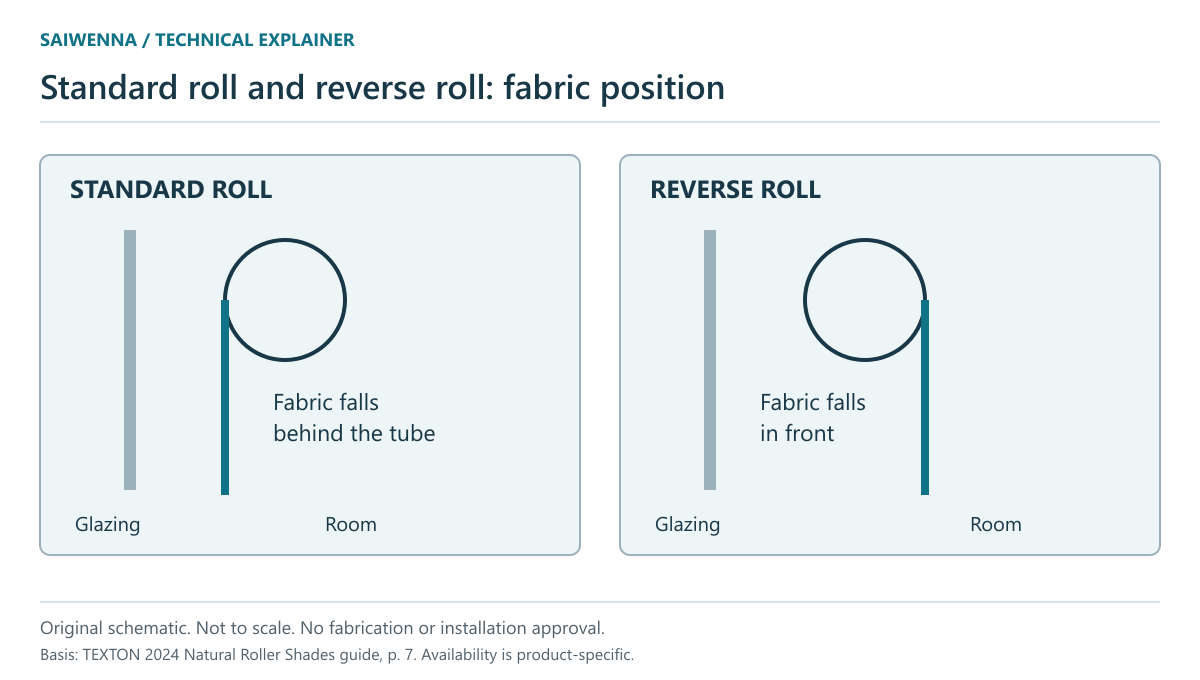
Two roll directions, two fabric paths
| Question | Standard roll | Reverse roll |
|---|---|---|
| Where does fabric descend? | From the window side of the tube | From the room side of the tube |
| What needs checking first? | Clearance to handles, cranks and glazing-side obstructions | Room-side projection, head treatment and side-view gaps |
| Can it fit inside or outside the opening? | Depends on the selected hardware and mounting detail | Depends on the selected hardware and mounting detail |
| Does it create complete blackout? | No. Fabric opacity and all perimeter details still matter | No. Moving the fabric plane changes the light path |
TEXTON’s 2024 Natural Roller Shades guide illustrates this distinction on printed page 7. It also restricts reverse roll for particular cassette and valance options in that collection. That is evidence that head-treatment availability must be checked by product, not a universal rule for every manufacturer.
Mark the section before choosing a direction
Use a side section with the glazing, finished frame, handle in its relevant positions, tube centre, maximum wound roll, fabric drop and bottom bar. Add the proposed cassette or fascia. A front-elevation photograph cannot show every collision along this path.
- Identify the required light control, view and privacy outcome.
- Mark obstructions along the full travel, including projecting handles and trim.
- Draw the standard and reverse fabric planes using the selected hardware’s actual dimensions.
- Check which head treatments permit the preferred direction.
- Confirm the final section with the supplier and installer before the opening schedule is released.
A handle that conflicts with the rear drop may be a reason to review reverse roll. It does not prove that reverse roll will clear the handle. The tube position, accumulated fabric and bottom-bar path still need dimensions.
Keep roll direction separate from three other choices
| Different choice | Why it remains separate |
|---|---|
| Inside versus outside mount | This describes the mounting relationship to the opening. It does not identify which side of the tube carries the fabric drop. |
| Motor rotation and limits | The commissioned motor direction must suit the supplied assembly. Reversing a command is not the same as changing the fabricated roll direction. |
| Opaque fabric versus a blackout assembly | Opaque cloth can still have perimeter light paths. Fabric position, side details, head treatment and the sill require their own review. |
The RC-MB10 sheet documents motor-side and idler-side gap references for its illustrated configuration. Those references are not universal deductions and cannot be turned into a guaranteed blackout gap after changing the roll direction or mounting arrangement.
Adjacent and double shades need a shared drawing
For adjacent windows, record the fabric plane and head-treatment alignment for every opening. A different roll direction may be necessary at one obstructed window, but the visual effect should be visible in the approved elevation and section.
For two fabrics on separate rollers, show both wound rolls, both fabric paths and both bottom bars. Do not assume that two independent single-shade brackets can share a cassette or that one vendor’s double-shade arrangement applies to another. Ask for the complete selected assembly and its permitted roll directions.
Confirm the selection with a reviewable brief
Include the opening section, obstruction dimensions, desired roll direction, fabric/head-treatment selection, mounting type and light-control objective. If room darkening is critical, specify the project’s acceptance conditions and examine the actual mock-up; do not use roll direction as the acceptance test.
Continue with inside versus outside mounting and light-gap assessment for those separate decisions. Use motorized roller shade systems to request review of the actual product configuration.
Related technical decision: Roller Shade Tube and Motor Matching: Diameter, Adapters and Torque.