Technical guide for window-treatment professionals
Railroaded Roller Shade Fabric: Width, Orientation and Seam Decisions
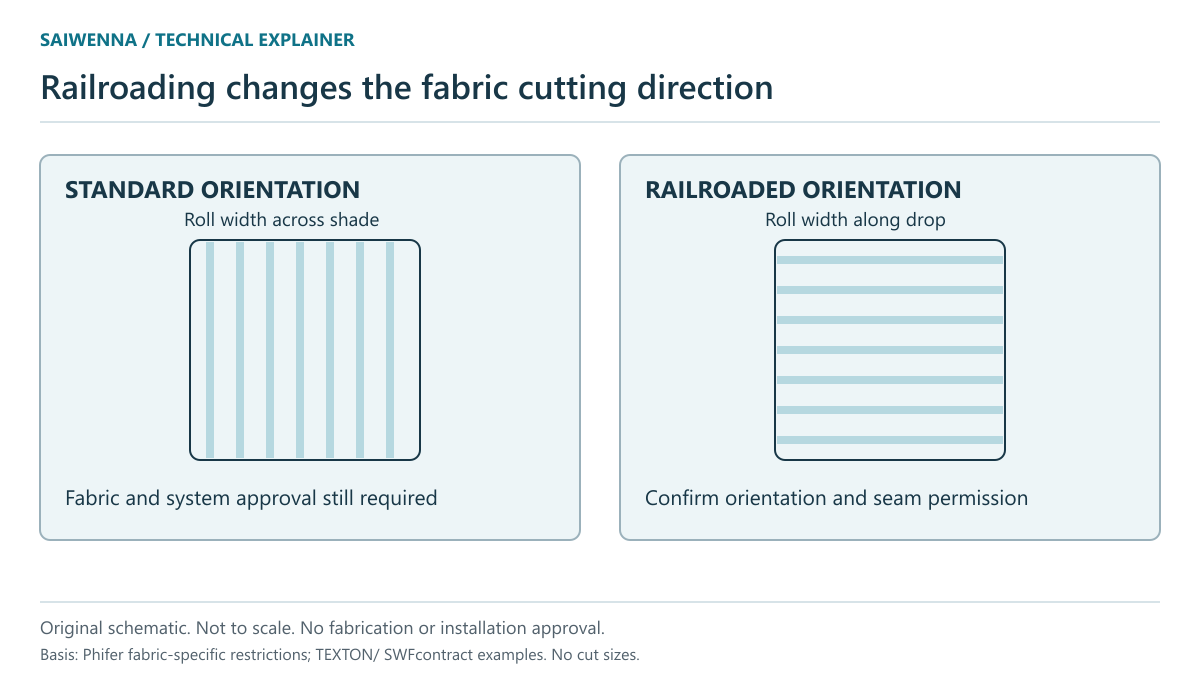
Railroading means turning the fabric orientation so that the roll width is used in the shade’s drop direction. It can change how a wide shade is fabricated, but only when the selected fabric and system permit it. A wider fabric layout does not automatically approve a larger tube, motor or completed shade.
Separate four dimensions before comparing options
| Dimension | What it describes | What it cannot establish alone |
|---|---|---|
| Opening width | The building opening or required coverage | The final fabric cut width |
| Fabric roll width | The stock material width before project-specific fabrication allowances | Every permitted finished shade width |
| Finished fabric width and drop | The specified shade band after approved fabrication details | Tube, motor and bracket capacity |
| Complete assembly envelope | The hardware, wound fabric, brackets and mounting relationship | A guaranteed seamless appearance |
On a conventional fabric layout, the roll width generally constrains the width available across the shade. Rotating the fabric changes which finished dimension draws from that roll width. The fabricator must still account for attachment, hems, trimming and any required seam or batten detail.
Permission to railroad is fabric-specific
Phifer’s current SheerWeave 7300/7350 product page expressly says that railroading is not recommended for those fabrics. That is a useful counterexample to the assumption that any roll can simply be turned sideways.
TEXTON’s 2019 roller-shade guide lists fabric-by-fabric railroading and seam options. Its historical examples demonstrate that the two decisions are separate: a fabric may allow one orientation while having a different seam restriction. The old guide is not a current Saiwenna availability or price list.
These manufacturers are cited as technical examples. Saiwenna supply of the named fabrics, colours and fabrication options must be confirmed for the actual inquiry.
A seam is a design decision that needs a location
If the required drop cannot be made from the available dimension in the approved orientation, the fabricator may need to review a seam, another fabric or a divided shade layout. Do not assume that a seam is invisible or that every fabric can be joined with the same process.
Record the proposed seam position from a defined reference, its appearance when extended and wound, and its alignment across adjacent shades. Manufacturer-provided SWFcontract specification language treats seam alignment and the use of battens as project coordination items. It does not grant a universal seam method for an unrelated fabric.
When the visual requirement excludes a seam, state that requirement before quotation. A proposal for a seamless fabric band is incomplete until the selected material, orientation, dimensions and system have been checked together.
Compare three real alternatives
| Alternative | Reason to investigate | Decision to document |
|---|---|---|
| Keep standard orientation | The approved roll width and fabrication allowances can satisfy the shade | Fabric code, cut direction and finished dimensions |
| Use approved railroaded orientation | The selected fabric permits rotation and the drop can be resolved | Orientation, texture/pattern appearance and seam decision |
| Divide the opening into modules | Material or system limits make one band impractical | Module boundaries, light gaps, hardware and operating groups |
A hypothetical 2.8 m-wide opening with a proposed fabric supplied at 2.5 m roll width should trigger this review. The difference alone cannot tell you the final cut width, whether railroading is permitted or whether two modules are necessary. Those are supplier and project decisions supported by drawings and material data.
Approve a fabric record and a system record together
The fabric record should include manufacturer and style code, colour/batch reference, roll width, approved orientation, finished band dimensions, seam/batten layout and the accepted sample. The system record should identify tube, motor, bracket, bottom bar, wound-roll envelope and the applicable size/load evidence.
For related decisions, use large-glazing layout planning, fabric consistency for phased orders and tube and motor matching. Send the material and drawing references with a roller-shade configuration inquiry; keep unconfirmed fabrication and supply fields open.