Technical guide for window-treatment professionals
Pleated vs Wave Curtains: Match the Heading to the Motorized Track
Choose the curtain heading and the track configuration together. A pleated-curtain reference does not automatically establish Wave or S-fold compatibility. The workroom and track supplier need the same attachment method, carrier arrangement, opening direction and clearance assumptions.
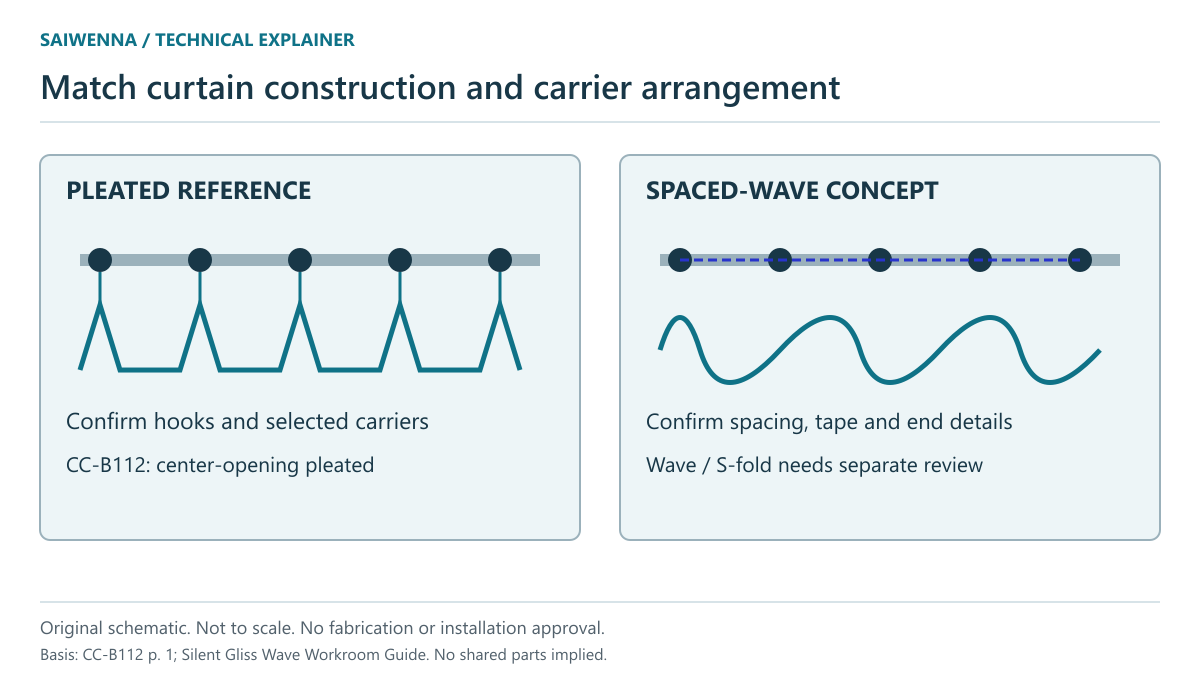
Start with the moving attachment, not the style photograph
A curtain photograph shows the desired appearance but rarely identifies the mechanism producing it. For a pleated arrangement, record the curtain’s actual hook or attachment positions and the selected gliders/carriers. For a spaced-wave arrangement, record how the carrier system controls spacing, how the heading is prepared and how the leading edge and returns are handled.
The CC-B112 technical sheet, page 1 identifies a center-opening pleated-curtain configuration and explicitly sends Wave and other arrangements for separate selection review. Its component drawing is not a universal Wave parts list.
What a documented Wave system demonstrates
Silent Gliss describes Wave as a heading system using a glider cord to control extension and create the repeating fabric form. Its workroom guide separates glider-cord spacing from hook spacing on the heading tape. The guide gives 60 mm and 80 mm cord options and explains their different fold-depth and stack implications.
These examples show why specifying “wave curtain” alone is incomplete. They do not establish that Silent Gliss parts fit CC-B112, that those spacings are Saiwenna stock options, or that another S-fold system uses the same tape and pocket rules. Use the exact selected system’s workroom instructions.
Resolve these interfaces before cutting fabric
| Interface | Workroom supplies | Track supplier confirms |
|---|---|---|
| Heading and attachment | Heading construction, tape or hook details, finished curtain reference | Approved glider/carrier and attachment combination |
| Spacing | Requested fold appearance and the selected heading recipe | Carrier-spacing mechanism and applicable part identities |
| Leading edge | Centre meet or single-stack intent; overlap and return appearance | Master-carrier, overlap arm and end arrangement |
| Parked curtain | Finished width, drop, fabric construction and available stack space | Movement envelope and track-end geometry |
| Clearance | Curtain depth at folds, lining and nearby surfaces | Track positions, motor envelope and route feasibility |
A model number for the motor does not answer these mechanical questions. Keep the curtain-side specification and the track-side bill of materials on the same revision.
Use a matched mock-up to settle the appearance
Ask for a representative curtain section made with the intended fabric, lining, heading and attachment components. Observe the deployed folds, parked stack, leading edge and return. If the track is motorized, evaluate the matched carrier arrangement during the intended movement; a loose fabric swatch cannot demonstrate that interface.
Record what the sample actually includes. A profile fragment demonstrates a profile and finish. A functional demonstration can show movement of its supplied configuration. Neither, by itself, approves a longer, heavier or curved project arrangement.
For example, changing from pleated to spaced-wave curtains after approving a recessed pocket can alter the fold depth and parked stack. The right action is to reopen the curtain/track section and workroom instructions before fabrication, rather than preserve the old pocket dimensions because the motor has not changed.
Keep heading approval separate from the purchase release
Capture the selected system, heading recipe, carrier/cord references, fabric construction, opening direction, overlap/return detail, sample reference and approved section. The workroom confirms curtain manufacture; the track supplier confirms the selected hardware; the local installer confirms the mounting and access conditions.
Use stack-back planning for the clear-opening task and the dealer sample checklist to define a functional evaluation. A request for motorized curtain tracks should name the intended heading and mark any unconfirmed compatibility. No Wave/S-fold supply configuration is approved by this explanatory comparison.