SAIWENNA / ROLLER ENGINEERING
Roller Shade Roll Diameter Calculator: Fabric Build-Up and Pocket Review
A bare roller tube is smaller than the fabric roll around it. This calculator estimates that build-up so a designer or shade contractor can identify a pocket question early. It does not select a motor, approve a bracket or establish a finished recess size.
Estimate the wound diameter
Use one consistent unit: millimetres. The length is the fabric actually wound around the tube in the position being assessed, including any retained wraps. It is not automatically the finished shade drop. Thickness is the selected material’s effective winding thickness; a fabric weight in g/m² cannot replace it.
Illustrative inputs. These are not a fabric recommendation or a confirmed RC-MB10 combination. The calculation runs only in your browser; inputs are not sent anywhere.
The calculation
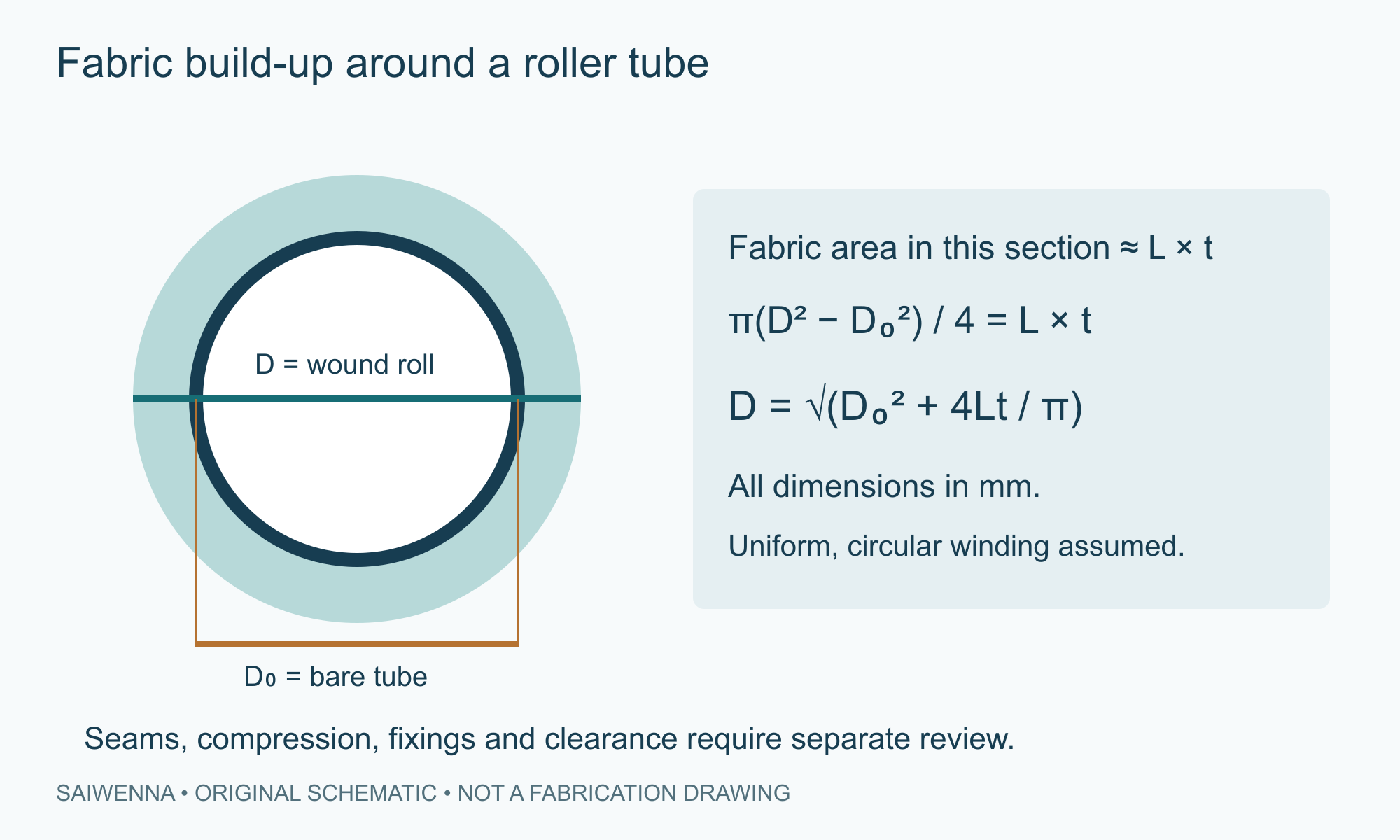
D = √(D₀² + 4Lt / π)
Imagine viewing the end of a uniformly wound roll. The fabric occupies an annulus around the tube. Its cross-sectional area is approximately length × thickness, so π(D² − D₀²)/4 = Lt. Rearranging gives the expression above. Fabric width cancels in this idealized cross-section; width still matters to tube deflection, motor selection and the real assembly.
This is an area-conservation estimate, not a layer-by-layer manufacturing model. It assumes uniform thickness, no air gaps or compression, a circular roll, and no local seam, weld, attachment or batten bulges.
A worked example—and a thickness sensitivity check
For a 50 mm outside-diameter tube, 3,000 mm of wound fabric and an assumed 0.50 mm thickness: D² = 2,500 + 6,000/π = 4,409.9 mm²; D ≈ 66.4 mm. The radial build-up is (66.4 − 50)/2 ≈ 8.2 mm on each side.
| Thickness | Wound length | Estimated diameter | Radial build-up |
|---|---|---|---|
| 0.30 mm | 3,000 mm | 60.4 mm | 5.2 mm |
| 0.50 mm | 3,000 mm | 66.4 mm | 8.2 mm |
| 0.80 mm | 3,000 mm | 74.5 mm | 12.3 mm |
A small-looking change in thickness can alter the space reservation. If a supplier offers only nominal thickness, retain its tolerance and ask whether a measured finished roll is available for the intended material and drop. Do not replace a missing thickness with an assumed value and then treat the result as an approval.
Turn the result into a section drawing question
- Identify the position. A fully raised shade, intermediate position and lowered shade have different wound lengths. Record the position used for the estimate.
- Keep the physical envelopes separate. Show the wound roll, bracket projection, motor head, idler, fascia and cable exit. A diameter says nothing about the clearance around all those parts.
- Check the moving path. Include the fabric face, hem bar and adjacent handle or mullion. For the path difference, use the standard versus reverse roll guide.
- Reserve service access. The roll fitting inside a pocket does not prove that the motor or fabric can be removed. Coordinate the opening with the pocket planning guide.
- Obtain assembly confirmation. The supplier and project team review the exact fabric, tube, adapters, brackets and section before fabrication.
Information to send for a roll-size review
Supply the opening reference, intended roll direction, finished drop, retained-wrap requirement, tube outside diameter, exact fabric code and thickness source. Add seams or battens, the preliminary section and the service-access requirement. Mark every unknown explicitly. Ask for the finished roll diameter and the approved assembly drawing for that combination, rather than asking whether a nominal tube “fits.”
Prepare the dimensional RFQ record Review commercial roller shade options
Sources and scope
- RC-MB10 Technical Data Sheet v1.0, 10 September 2026, pp.1 and 4
- Calculation: original area-conservation derivation and independent arithmetic checks
Technical reference reviewed 20 October 2026. Manufacturer examples retain their own product scope. Final supply, pricing, lead time and project suitability require configuration-specific confirmation.