Technical guide for window-treatment professionals
Motorized Curtain Track Load Ratings: Brackets, Curves and Fabric Weight
A bracket rating, a curved-track load and a motor torque figure answer different questions. A reliable specification keeps their units, mounting conditions and route assumptions attached to each value. Adding bracket ratings together does not establish the allowable curtain weight of the assembled system.
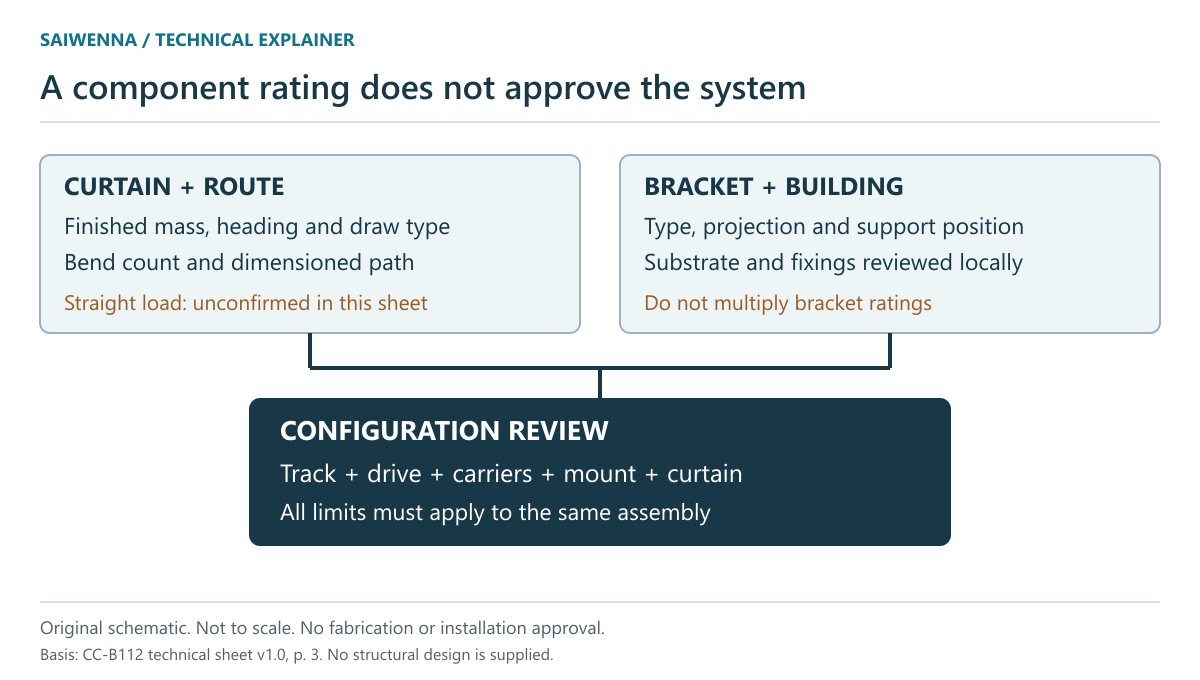
Read the CC-B112 values in their original context
| Source item | Documented reference | What it does not establish |
|---|---|---|
| Single-curve route | 20 kg | A straight-track rating or every curved layout |
| Two-curve route | 15 kg | Approval for an arbitrary multi-bend route |
| Ceiling bracket | 20 kg per bracket | The assembled track capacity multiplied by bracket count |
| Single-track wall bracket | 18 kg at 85 mm offset; 15 kg at 100 mm offset | A rating for an unknown projection, fixing or substrate |
| Double-track wall bracket | 2 × 6 kg in the documented arrangement | 12 kg available to either rail individually |
These are references from CC-B112 technical sheet v1.0, page 3. The curve data is associated with 2.2× fullness and 400 g/m² fabric. The table does not give a straight-route system load. Keep that field unconfirmed until the supplier supplies the applicable rating and configuration.
Estimate the curtain input before reviewing the system
For a preliminary fabric-only estimate, multiply the actual fabric area by its mass per unit area. If starting from the finished coverage width, fullness can help estimate fabric width, provided the curtain maker confirms how fullness is defined for the chosen heading.
Illustrative input: 3.0 m coverage × 2.5 m drop × 2.2 fullness × 0.400 kg/m² = 6.6 kg of fabric before additional material and hardware. This arithmetic is an estimate for the fabric brief, not a tested curtain mass or a system approval.
The workroom must account for hems, returns, overlaps, linings, weights and heading construction. Supply the resulting finished curtain weight or a measured sample basis. Keep sheer and blackout layers separate. A heavy lining can change the input even when the visible fabric and opening width stay the same.
Four checks that a high bracket number cannot replace
- Route: match the straight segments, bend count and geometry to the specific track evidence. A maximum length is not a load rating.
- Moving components: confirm carriers, belt, drive and the finished curtain arrangement for the route.
- Mounting hardware: match bracket type, projection, locations and joint-support details to the approved drawing.
- Building support: the responsible local designer or installer must confirm the substrate and fixings. A component table does not verify a wall, ceiling or anchor.
The CC-B112 route reference also lists a 200 mm minimum radius, a maximum 90° per curve and at least 600 mm between curves. Those geometric conditions must accompany a review of the associated curve loads; they are not a license to approve every drawing inside the numbers.
A useful way to mark an incomplete quotation
| Quotation statement | Review response |
|---|---|
| “Four brackets rated 20 kg each, so 80 kg curtain” | Do not accept the sum as a system rating. Request the track/drive/route capacity and mounting design. |
| “Motor torque is 1.2 Nm, therefore it carries this weight” | Torque is not a curtain-mass rating. Request model-specific system evidence. |
| “A 20 kg curve rating applies to the straight track” | The source does not establish that transfer. Keep straight-load capacity unconfirmed. |
| “Same fabric, new lining” | Recheck the finished mass and route configuration before repeating the order. |
A reviewable schedule shows the opening ID, finished mass, heading, draw type, route revision, motor, carriers, bracket arrangement and the document supporting each limit. Missing evidence should be visible in its own field.
Take a complete load question to the supplier
Send the route drawing and finished curtain information with the track selection pack. Use stack-back planning to check the parked curtain and clear-opening requirement separately from load.
For a proposed Saiwenna configuration, start from the track systems page and ask for the allowable finished curtain mass for that exact route and mounting arrangement. This guide explains how to read the evidence; it supplies no structural fixing design.
Related technical decision: Motorized Curtain Track Splices: Rail, Belt and Carrier Connections.