Technical guide for window-treatment professionals
Motorized Curtain Track Splices: Rail, Belt and Carrier Connections
A curtain-track connector can describe several different parts. Before ordering a sectional motorized track, identify whether the quotation means the rail splice, a belt connector or a connection within the master-carrier assembly. They solve different problems and cannot be substituted for one another.
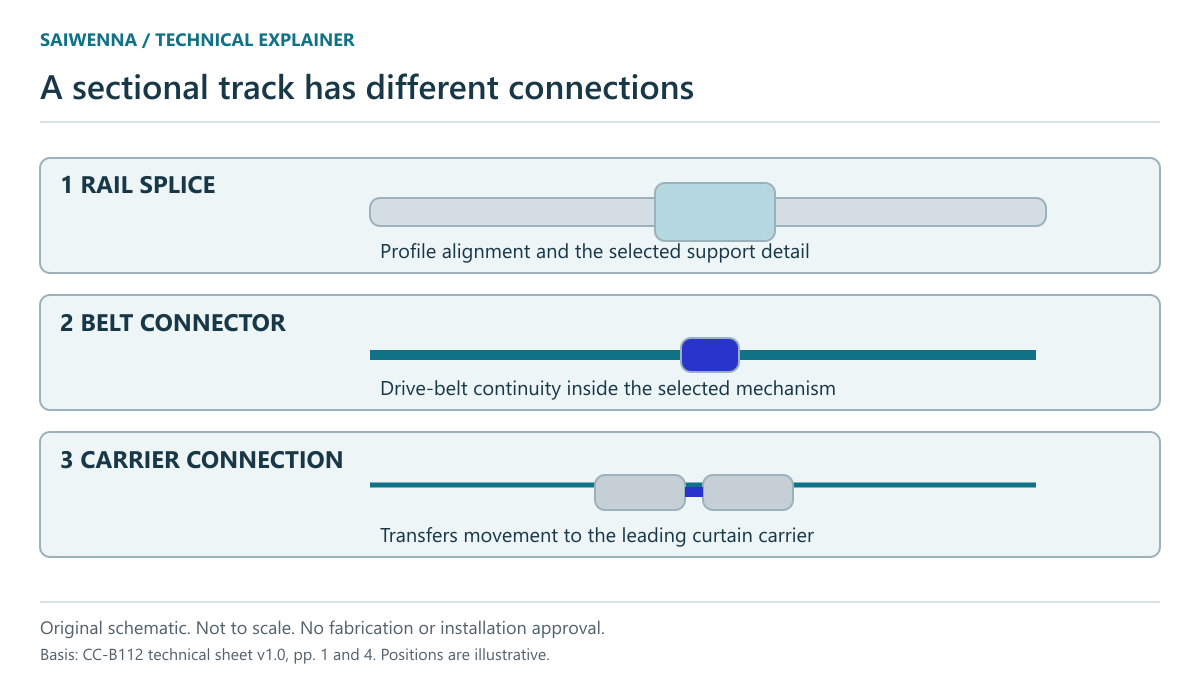
Three connections to keep separate
| Connection | What it joins | What to request |
|---|---|---|
| Rail splice | Adjacent lengths of the track profile | Profile identity, splice position and the approved fixing/support detail |
| Belt connector | The drive belt within the selected mechanism | Correct belt and connector references, routing and factory assembly instructions |
| Master-carrier connection | Parts that transfer belt movement to the curtain-leading carrier | Draw type, carrier arrangement and a labeled assembly reference |
The CC-B112 assembly drawing labels the belt connector and master-carrier connector separately from the track. Its profile description calls for a track joiner above 3.5 m or when splitting is necessary. This is a joiner-use condition, not a universal maximum length or a promise that every project should be divided at 3.5 m. See the CC-B112 technical sheet, pages 1 and 4.
Turn a shipping constraint into a section plan
Begin with the finished route and the actual access limit. The carrier route, motor end, opening direction and curtain stack must remain understandable after the track is split. Package length, track-section length and completed operating length should be separate fields.
For example, a project may have a 4.8 m finished straight route and an access restriction that prevents one-piece delivery. Those two facts justify a section review. They do not establish two equal pieces, a permitted splice location or a belt-cutting instruction. Ask the factory to return a labeled section plan before accepting the packing proposal.
- Assign the opening a stable ID and mark the motor and return ends.
- Show the proposed joint on the route drawing and dimension each section from a stated reference.
- List the rail connector, belt-related parts and carrier parts as separate supply items.
- Ask whether the belt and carriers arrive assembled, secured for transport or requiring a documented local procedure.
- Identify who checks alignment, support, movement and limits after assembly.
Why another manufacturer’s splice instructions are not a universal method
Rowley’s Finestra Custom R-TEC single-splice instructions distinguish the track splice from the master-carrier connection and warn against pinching the belt. The document also specifies support beside the splice for that product. It is useful evidence that a joint affects both movement and support, but its bracket spacing, load rating and assembly steps do not become CC-B112 specifications.
Lutron likewise lists spliced and unspliced options in its US/Canada drapery chassis submittal. Its permitted lengths belong to the documented Lutron system. Keep the selected supplier’s drawing and instructions as the authority for the ordered track.
What the receiving installer should be able to identify
| Record | Acceptable handoff | Leave open if missing |
|---|---|---|
| Opening and revision | Same ID on the drawing, package and component list | Which room or version the parts belong to |
| Section sequence | Numbered sections with motor/end orientation | A guessed order based on package appearance |
| Connectors and supports | Part references linked to the selected track | Generic joiners or improvised support spacing |
| Completion evidence | Named installer, observed full travel and documented limit setup | Assumed operation from a loose-profile sample |
If a carrier catches at a joint or a connector is missing, record the opening ID and the visible condition and request the selected assembly instructions. Forcing the carrier or inventing a belt repair can hide an incorrect section or component.
Prepare the next track review
Use the existing track selection pack for the complete route brief and its component-map PDF. Add the section drawing, maximum package length, local access restriction and assembly responsibility. For curved routes, continue with the curved-track specification guide.
Then review motorized curtain track systems with the intended finished curtain, mounting condition and control arrangement. Final splice positions and supply scope remain subject to the approved configuration.
Related technical decision: Motorized Curtain Track Load Ratings: Brackets, Curves and Fabric Weight.